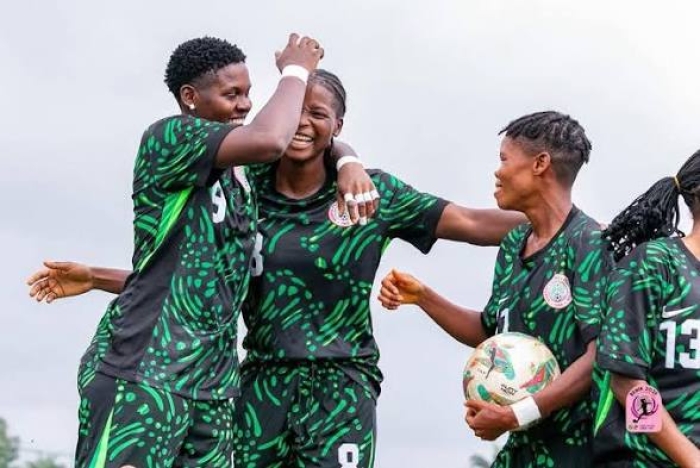
Nigeria’s women’s football setup is heading for a structural reset after world football governing body FIFA introduced a sweeping new rule mandating the inclusion of female coaches and officials across all women’s teams competing in its tournaments.
The directive, approved at a FIFA Council meeting on Thursday, requires that every team must have either a female head coach or at least one female assistant coach. In addition, one member of the medical team and two officials on the bench must also be women; a move FIFA says is designed to align the women’s game with its growing investment and push for gender balance.
For Nigeria, the implications are immediate and unavoidable. The country’s three main women’s national teams: the Super Falcons, Flamingos (U-17), and Falconets (U-20) are currently led by male coaches: Justin Madugu, Bankole Olowookere, and Moses Aduku respectively. Under the new rule, these teams must quickly integrate female professionals into key technical and backroom roles to remain eligible for international competitions.
The shift also throws a spotlight on Nigeria’s long-standing gender gap in coaching within the women’s game. Despite the country’s dominance in African women’s football, only two women; Uche Eucharia and Florence Omagbemi have ever managed the Super Falcons, with Omagbemi’s tenure ending in 2016. Since then, leadership of the team has remained firmly in male hands.
FIFA insists the reform is part of a broader global push to ensure women are not just participants on the pitch but decision-makers on the sidelines. With investment in women’s football rising sharply, the governing body argues that the sport must increasingly be shaped by women who understand its dynamics firsthand.
Beyond coaching reforms, FIFA also unveiled a series of forward-looking decisions aimed at expanding and safeguarding the women’s game. Hosts for the 2031 and 2035 FIFA Women’s World Cups will be confirmed before the end of 2026, with joint bids already emerging from the Americas and the United Kingdom. The 2031 edition is set to become the largest ever, expanding to 48 teams.
FIFA further approved a new safeguarding policy to protect players and officials from harassment and abuse, alongside adjustments to the international calendar. The 2026 Women’s Africa Cup of Nations will run from July 26 to August 16, while Morocco will host the FIFA U-17 Women’s World Cup from October 17 to November 7.
What to Know:
FIFA’s directive exposes a long-standing contradiction in Nigeria’s women’s football; global success on the pitch built on a system that has largely excluded women from leadership off it. While the policy could accelerate overdue inclusion and create pathways for qualified female professionals, its impact will depend on how seriously Nigeria treats implementation. A rushed, box-ticking approach risks tokenism, where women are added without real authority or development support. Without deliberate investment in coaching education, mentorship, and career pipelines for women, the country could struggle to meet the requirement meaningfully turning what should be a structural correction into a superficial compliance exercise.
Do you have a news to share with us, or you would like to partner with us or make advert enquiry or support Kindly reach out to us on +2348036828367.