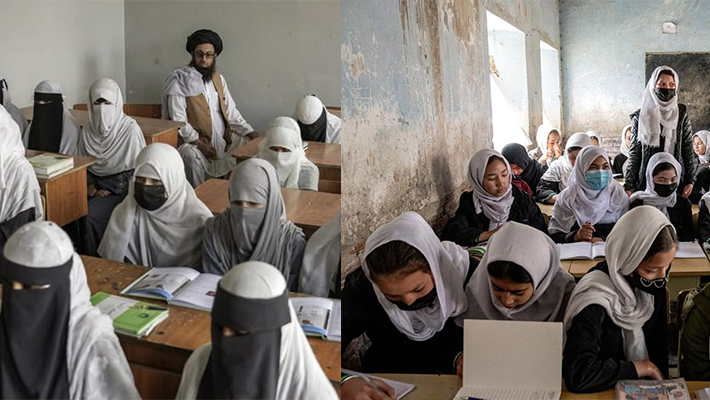
More than 2.4 million girls have been denied access to secondary education in Afghanistan since the Taliban returned to power in 2021, the United Nations Educational, Scientific and Cultural Organisation, UNESCO, has said.
The agency warned that the number could rise to about 4 million by 2030 if the restrictions remain in place, following an increase of about 200,000 girls affected over the past year.
Afghanistan remains the only country where girls and women are formally barred from secondary and higher education, according to UNESCO.
Hoda Jaberian, UNESCO’s programme coordinator for education in emergencies, said the prolonged restrictions amounted to the loss of almost an entire secondary school cycle for affected girls.
“Five years is not a temporary interruption in a child’s education. It is clearly almost an entire secondary school cycle,” she said.
The Taliban initially assured the international community after its return to power on August 15, 2021, that girls would be allowed to continue their education.
However, secondary schools were subsequently closed to girls in 2022, while women were later banned from attending universities.
Female teachers have also been removed from the education system, with UNESCO warning that the restrictions could contribute to a shortage of more than 11,000 female teachers by 2030.
Jaberian said the restrictions had reversed significant gains made in girls’ education over the past 2 decades.
She noted that while relatively few girls attended primary school in 2001, nearly 1 million were enrolled in secondary education by 2021.
“Afghanistan had made really major progress in expanding girls’ access to education,” she said. “But unfortunately, much of that progress now has been completely reversed.”
The consequences extend beyond education, with UNESCO estimating that at least 600,000 women could be unemployed by 2026 because of the restrictions.
The agency also estimated that the education and employment restrictions could result in cumulative income losses of about $9.6 billion and increase the risk of early marriage.
Women in Afghanistan also continue to face restrictions on employment and access to several public spaces, including parks, gyms and salons.
UNESCO urged the Taliban authorities to immediately restore girls’ access to secondary and higher education.
The agency said it was providing alternative learning opportunities, including community-based literacy programmes, skills development and psychosocial support, while calling for the restoration of formal education rights for Afghan girls and women.
Do you have a news to share with us, or you would like to partner with us or make advert enquiry or support Kindly reach out to us on +2348036828367.