Nigeria’s 2027 presidential campaign has officially begun, setting the stage for a contest over the country’s economy, security, education, healthcare and political structure.
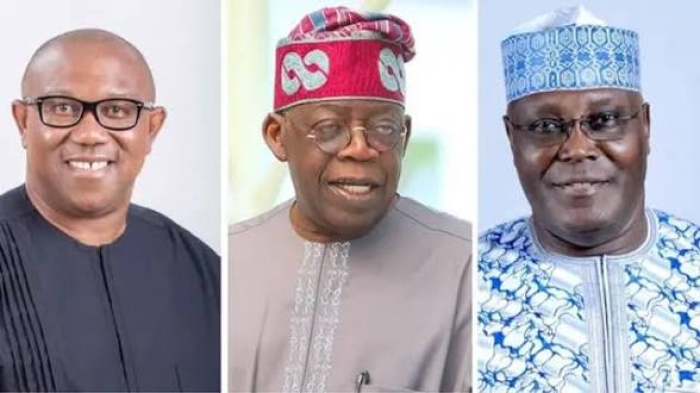
President Bola Tinubu of the All Progressives Congress (APC) is seeking a second term, while former Vice President Atiku Abubakar of the African Democratic Congress (ADC) and Peter Obi of the Nigeria Democratic Congress (NDC) are among the major opposition contenders.
Other candidates, including Omoyele Sowore of the African Action Congress (AAC), Donald Duke of the Peoples Redemption Party (PRP) and Adewole Adebayo of the Social Democratic Party (SDP), are also presenting alternative policy proposals ahead of the January 16, 2027 presidential election.
The emerging campaign is largely centred on whether Nigeria should continue with Tinubu’s economic reforms, adopt a production-driven recovery programme or pursue deeper political and economic restructuring.
Tinubu seeks second term on Renewed Hope agenda
Tinubu is campaigning on the Renewed Hope Agenda and the administration’s 2026–2030 development plan.
His administration argues that the removal of petrol subsidy, foreign exchange liberalisation and revenue reforms introduced during his first term have laid the foundation for long-term economic growth.
Although the President has acknowledged the hardship caused by the reforms, he has maintained that reversing them would return the country to the fiscal and economic problems the policies were designed to address.
The administration is targeting a $1 trillion economy by 2030, with emphasis on manufacturing, infrastructure, agriculture and economic diversification.
Major infrastructure projects, including the Kano-Maradi railway, are being highlighted as evidence of the government’s investment drive.
On security, Tinubu is expected to campaign on reforms introduced since 2023 and promise to consolidate the gains made in tackling insecurity.
APC National Chairman Nentawe Goshwe Yilwatda has said the party will seek a fresh mandate based on its record.
The party has also indicated that the next phase of its programme will focus more on translating economic improvements into direct benefits for households.
Atiku promises production-led recovery
Atiku is presenting what he describes as a production-driven alternative focused on security, economic recovery, education, healthcare and restructuring.
His security proposals include expanding the police and armed forces, improving equipment and strengthening intelligence gathering and coordination among security agencies.
He has also promised free and compulsory primary and secondary education, increased investment in technology and entrepreneurship, as well as stronger primary and specialist healthcare.
A major part of his economic programme is a proposed production subsidy for qualifying public and private refineries.
Under the proposal, refineries would receive domestic crude at preferential prices, subject to production, efficiency, transparency and domestic supply requirements.
The proposal would have a fixed annual spending limit, independent audits and an exit mechanism as domestic refining capacity and competition improve.
Atiku has also called for a public reconciliation of about N30 trillion in Federation Account entries linked to petroleum revenues, deductions and transfers.
His wider agenda includes a living wage, food security, stronger public spending audits, devolution of powers and greater autonomy for states.
Obi campaigns on production and human capital
Obi is campaigning on moving Nigeria “from consumption to production”.
His programme focuses on agriculture, manufacturing, exports, fiscal discipline and human-capital development.
He plans to improve security in farming communities, expand irrigation, upgrade rural roads and storage facilities, and connect farmers with finance and markets.
He has also promised greater support for agro-processing and manufacturing to reduce Nigeria’s dependence on imported goods.
On public finances, Obi proposes reducing wasteful government spending and linking expenditure to measurable results.
His security plan includes improved intelligence, technology-driven policing, better border management and greater decentralisation while maintaining federal coordination.
His education proposals cover basic education, universities, technical education and vocational training, while his healthcare agenda focuses on primary healthcare, access to essential medicines and reducing maternal and infant mortality.
Obi has also outlined different development priorities for Nigeria’s geopolitical zones, including agriculture and livestock in the North-West, reconstruction and trade in the North-East, food processing and solid minerals in the North-Central, manufacturing and technology in the South-West, entrepreneurship and infrastructure in the South-East, and value-added petroleum, maritime and fisheries development in the South-South.
Sowore, Duke and Adebayo present alternatives
Sowore is proposing what he describes as revolutionary change, including free education at all levels, the abolition of WAEC and NECO fees, the use of artificial intelligence in public financial management and increased deployment of drones for security operations.
Duke is focusing on education, healthcare, infrastructure, security and justice reform.
He argues that Nigeria’s economic performance should be measured by employment, household income and living standards rather than government revenue and foreign reserves alone.
Adebayo’s five-point agenda focuses on insecurity, unemployment, low productivity, inadequate electricity and weak institutions.
He has proposed 75,000 megawatts of power generation and warned against excessive concentration of political authority.
As the campaign progresses, the credibility of the competing programmes is expected to depend largely on how clearly candidates explain the cost, funding sources, implementation timelines and measurable targets of their promises.
With the presidential election scheduled for January 16, 2027, voters are likely to face a major choice between continuity, economic restructuring and alternative approaches to governance.
Do you have a news to share with us, or you would like to partner with us or make advert enquiry or support Kindly reach out to us on +2348036828367.