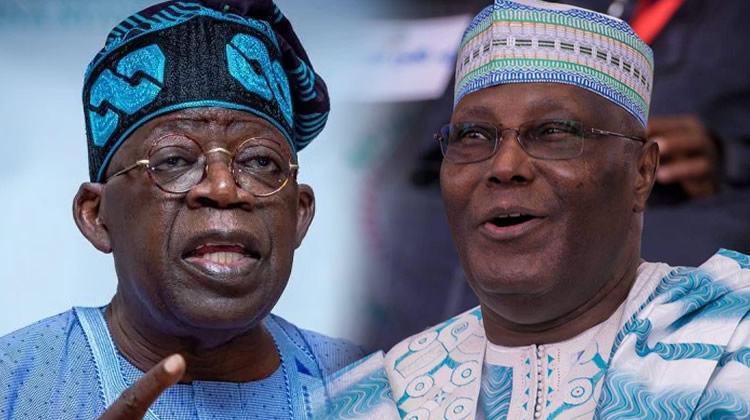
Former Vice President Atiku Abubakar has criticised the economic policies of President Bola Ahmed Tinubu, citing the latest Central Bank of Nigeria (CBN) Household Expectations Survey as evidence of declining household purchasing power.
Atiku, the presidential candidate of the African Democratic Congress (ADC), spoke on Saturday through his Senior Special Assistant on Public Communication, Phrank Shaibu.
He said the survey painted a troubling picture of an economy where many Nigerians were postponing plans to purchase homes, vehicles and household goods because of financial constraints.
According to the CBN survey, buying conditions stood at 28.7 points for motor vehicles, 28.9 points for consumer durables and 30.0 points for buildings and landed property.
The survey also put willingness to purchase vehicles at 18.7 points, while willingness to purchase buildings and landed property stood at 19.2 points.
Reacting to the figures, Atiku described them as a reflection of the financial pressures facing Nigerian households and accused the Tinubu administration of relying too heavily on favourable macroeconomic indicators while ignoring the experiences of ordinary citizens.
“These are not figures manufactured by the opposition. They are the verdict of Nigerian households captured by the Central Bank under President Tinubu’s own government,” Atiku said.
He argued that rising costs of food, transportation, electricity, education and other necessities had left families with little disposable income for savings, investment or the acquisition of assets.
Atiku also referenced the latest SBM Intelligence Jollof Index, which he said showed that the average cost of preparing a pot of jollof rice for a family of 5 had risen to about ₦29,578.
He said the figure represented more than 40 per cent of the ₦70,000 minimum wage, arguing that the rising cost of basic necessities was making it increasingly difficult for households to pursue longer-term financial goals.
“Tinubu first stole jollof rice from the family dining table. Now, his economy is taking away the house in which the table should stand and the car with which the breadwinner should get to work,” he said.
The former vice president further criticised the government for celebrating indicators such as GDP growth and foreign reserves while, according to him, household purchasing power remained under pressure.
He described this approach as “PowerPoint economics”, arguing that the true measure of economic performance should be how much ordinary Nigerians can afford.
“The real economy is the Nigerian family’s pocket, and that pocket is increasingly empty,” he said.
Atiku also warned that weak household purchasing power could have wider consequences for businesses and employment, arguing that reduced consumer spending could affect sales, production and ultimately jobs.
“An economy is not successful merely because government officials can quote favourable statistics. An economy succeeds when citizens can work, earn, eat, save, invest and progressively improve their standard of living,” he said.
The ADC presidential candidate called for economic policies that would improve household incomes and purchasing power, saying Nigerians should be able to meet their basic needs while gradually improving their living standards.
“Before there is GDP, there must be dinner. Before there is prosperity, there must be purchasing power,” Atiku said.
Do you have a news to share with us, or you would like to partner with us or make advert enquiry or support Kindly reach out to us on +2348036828367.