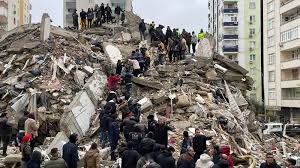
Rescue workers made a final push Thursday to find survivors of the earthquake in Turkey and Syria that rendered many communities unrecognizable to their inhabitants and led the Turkish president to declare it “the disaster of the century.” The death toll topped 20,000.
Mehmet Yilmaz, 67, watched from a distance as bulldozers and other demolition equipment began to bring down what remained of the building where six of his family members had been trapped, including four children.
He estimated that about 80 people were still beneath the rubble and doubted that anyone would be found alive.
“There’s no hope. We can’t give up our hope in God, but they entered the building with listening devices and dogs, and there was nothing,” Yilmaz said.
Mehmet Nasir Dusan, 67, sat watching as the remnants of the nine-story building were brought down in billowing clouds of dust. He said he held no hope of reuniting with his five family members trapped under the debris.
Still, he said, recovering their bodies would bring some small comfort.
“We’re not leaving this site until we can recover their bodies, even if it takes 10 days,” Dusan said. “My family is destroyed now.”
In Kahramanmaras, the city closest to the epicenter, a sports hall the size of a basketball court served as a makeshift morgue to accommodate and identify bodies.
On the floor lay dozens of bodies wrapped in blankets or black shrouds. At least one appeared to be that of a 5- or 6-year-old.
At the entrance, a man wept over a black body bag that lay next to another in the bed of a small truck. “I’m 70 years old. God should have taken me, not my son,” he cried.
Workers continued to conduct rescue operations in Kahramanmaras, but it was clear that many who were trapped in collapsed buildings had already died. One rescue worker was heard saying that his psychological state was declining and that the smell of death was becoming too much to bear.
In northwestern Syria, the first U.N. aid trucks since the quake to enter the rebel-controlled area from Turkey arrived, underscoring the difficulty of getting help to people there. In the Turkish city of Antakya, dozens scrambled for aid in front of a truck distributing children’s coats and other supplies.
One survivor, Ahmet Tokgoz, called for the government to evacuate people from the region. Many of those who have lost their homes found shelter in tents, stadiums and other temporary accommodation, but others have slept outdoors.
“Especially in this cold, it is not possible to live here,” he said. “If people haven’t died from being stuck under the rubble, they’ll die from the cold.”
The winter weather and damage to roads and airports have hampered the response. Some in Turkey have complained that the government was slow to respond — a perception that could hurt Turkish President Recep Tayyip Erdogan at a time when he faces a tough battle for reelection in May.
“As you know, the earthquake hit an area of 500-kilometer (311-mile) diameter where 13.5 million of our people live, and that made our job difficult,” Erdogan said Thursday.
In the Turkish town of Elbistan, rescuers stood atop the rubble from a collapsed home and pulled out an elderly woman.
Rescue teams urged quiet in the hopes of hearing stifled pleas for help, and the Syrian paramedic group known as the White Helmets noted that “every second could mean saving a life.”
But more and more often, the teams pulled out dead bodies. In Antakya, more than 100 bodies were awaiting identification in a makeshift morgue outside a hospital.
With the chances of finding people alive dwindling, crews in some places began demolishing buildings. Authorities called off search-and-rescue operations in the cities of Kilis and Sanliurfa, where destruction was not as severe as in other areas. Vice President Fuat Oktay said rescue work was mostly complete in Diyarbakir, Adana and Osmaniye.
Across the border in Syria, assistance trickled in. The U.N. is authorized to deliver aid through only one border crossing, and road damage has prevented that thus far. U.N. officials pleaded for humanitarian concerns to take precedence over wartime politics.
It wasn’t clear how many people were still unaccounted for in both countries.
Turkey’s disaster-management agency said more than 110,000 rescue personnel were now taking part in the effort and more than 5,500 vehicles, including tractors, cranes, bulldozers and excavators had been shipped. The Foreign Ministry said 95 countries have offered help.
Do you have a news to share with us, or you would like to partner with us or make advert enquiry or support Kindly reach out to us on +2348036828367.