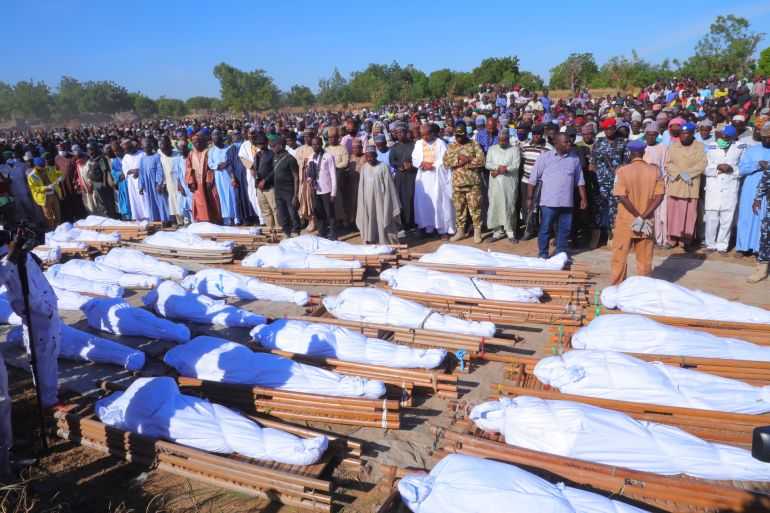
Recent attacks on schools in Borno and Oyo states have once again drawn national attention to Nigeria’s persistent security challenges, raising concerns over the safety of citizens and public institutions across the country.
On 15 May 2026, armed men reportedly invaded Government Day Junior Secondary School in Askira-Uba Local Government Area of Borno State and abducted dozens of pupils. On the same day, three schools in Orire Local Government Area of Oyo State were also attacked, with several pupils and teachers reportedly kidnapped.
The incidents have revived painful memories of previous mass abductions, including the Chibok and Dapchi school kidnappings, which brought global attention to Nigeria’s security crisis.
The attacks came just days before the National Day of Mourning and Remembrance and have further highlighted the growing scale of violence affecting communities, schools, markets and public spaces across the country.
Data obtained from the Mass Atrocities Tracker and analysed by investigative platform ICIR shows that no fewer than 32,667 people were killed in Nigeria between 2021 and April 2026. During the same period, at least 23,187 people were kidnapped.
The figures, which cover deaths linked to insurgency, banditry, communal conflicts and separatist-related violence, reveal that insecurity remains widespread despite ongoing military operations and government assurances.
According to the data, 6,895 people were killed in 2021, while 5,792 deaths were recorded in 2022. The number dropped to 4,416 in 2023 before rising again to 5,353 in 2024. In 2025, fatalities climbed to 6,518, while 3,693 deaths had already been recorded between January and April 2026.
Borno State recorded the highest number of killings during the period with 5,706 deaths, largely due to the activities of Boko Haram and ISWAP insurgents. Zamfara followed with 4,396 deaths, while Benue recorded 2,948 fatalities. Kaduna and Plateau states also recorded significant casualties, with 2,851 and 2,471 deaths respectively.
Security experts attribute Borno’s position as the deadliest state to the prolonged insurgency that has plagued the North-East for over a decade. The activities of Boko Haram and ISWAP have resulted in repeated attacks on communities, military formations, highways and displaced persons.
In Zamfara, widespread banditry continues to fuel violence. Armed groups operating from forested areas have repeatedly attacked villages, imposed illegal levies on residents and carried out mass abductions for ransom. Several communities have reportedly been abandoned as residents flee for safety.
Benue, Kaduna and Plateau have also remained flashpoints due to recurring farmer-herder clashes, communal conflicts and other forms of armed violence, leading to thousands of deaths and displacement of residents.
Kidnapping remains one of the most alarming dimensions of Nigeria’s security crisis. The data shows that at least 23,187 people were abducted between 2021 and 2026.
A breakdown indicates that 5,663 people were kidnapped in 2021 and 5,162 in 2022. The figure dropped to 2,653 in 2023 before rising again to 5,171 in 2024. In 2025, 3,033 kidnappings were recorded, while 1,505 cases had already been documented between January and April 2026.
Zamfara topped the list of states with the highest number of kidnapping victims, recording 5,676 cases. Kaduna followed with 4,394, while Niger State recorded 3,597 kidnappings. Katsina reported 2,079 cases, with Sokoto, Borno, Kebbi and Taraba also experiencing significant incidents.
Speaking during a conflict-focused dialogue to mark the 2026 National Day of Mourning, Co-Chair of the Community of Practice Against Mass Atrocities in Nigeria, Ken Henshaw, described the continued rise in killings and kidnappings as evidence of government failure to adequately protect lives and property.
According to him, the persistence of violence across multiple administrations points to deeper structural problems within Nigeria’s security architecture.
He argued that attacks carried out by insurgents, bandits, separatist groups and communal militias continue to expose civilians to danger, displace communities and destroy livelihoods across the country.
Henshaw also criticised the increasing use of amnesty programmes for armed groups, warning that such measures could weaken accountability and reduce pressure on authorities to prosecute offenders.
He further noted that the country’s security institutions remain overstretched and under-resourced, while the deployment of police personnel for VIP protection continues to affect public safety and security operations.
As fresh attacks on schools and communities continue to emerge, concerns are growing over the ability of security agencies to effectively stem the tide of violence and restore confidence among citizens.
Do you have a news to share with us, or you would like to partner with us or make advert enquiry or support Kindly reach out to us on +2348036828367.