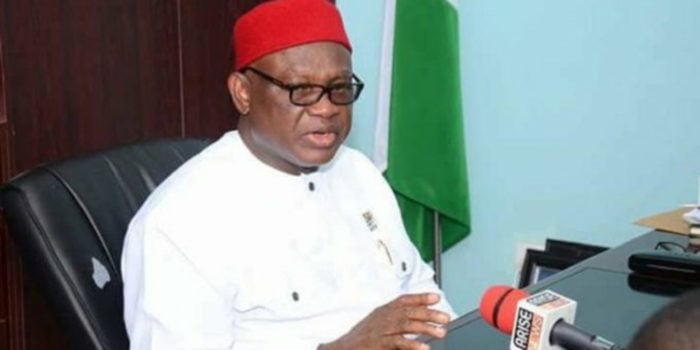
2027: Peter Obi Will Get More Votes in Lagos Than in 2023, Says Chekwas Okorie
Chief Chekwas Okorie, pioneer National Chairman of the All Progressives Grand Alliance (APGA) and President of Igbo Agenda Dialogue, has expressed confidence that Peter Obi will secure more votes in Lagos State in the 2027 presidential election than he did in 2023.
Okorie, who made the prediction while speaking with journalists in Abuja on Wednesday, said increased political mobilisation among Igbo voters and other supporters would boost Obi’s electoral performance in the state.
Obi, the presidential candidate of the Nigerian Democratic Congress (NDC), is expected to be a major contender in the 2027 election.
During the interaction, Okorie addressed three major political issues: comments attributed to Anambra State Governor Chukwuma Soludo concerning Obi, claims that Northerners would not support an Igbo presidential candidate, and the position of the Minister of the Federal Capital Territory, Nyesom Wike, who has declared that Rivers State and the FCT belong to President Bola Tinubu.
Okorie Tackles Soludo Over Obi
Reacting to the reported comments by Soludo, Okorie reminded the Anambra governor that he and Obi were products of APGA, arguing that political differences should not overshadow the broader interests of the country.
He cited the outcome of the Osun State governorship election as an example of how voters could assert their preferences despite the influence of federal political power.
According to him, the political developments in Osun should serve as a lesson to Soludo, particularly as political alignments continue to shift ahead of the 2027 elections.
Okorie also pointed out that Senator Ademola Adeleke, who won the Osun governorship election on the platform of the Accord Party, subsequently declared support for Tinubu’s re-election bid.
He suggested that Adeleke’s position demonstrated that political leaders could make independent choices regardless of their parties’ electoral contests.
“We therefore wonder why Professor Soludo would not take a cue from that example,” Okorie said.
He further recalled that Soludo was the first governor to endorse Tinubu, even before governors elected on the platform of the All Progressives Congress (APC) did so.
“We believe his current position is driven by a personal grievance. Consequently, we do not intend to waste our time engaging him further because the task before us is far greater than any individual,” he added.
The APGA pioneer chairman also warned that Soludo could face political challenges if Obi’s party performed strongly in the Anambra State House of Assembly election.
He challenged the governor to demonstrate his political influence by securing a significant share of the state’s votes for Tinubu in 2027.
“In the 2023 presidential election, Tinubu secured only 5.3 per cent of the votes cast in the South-east. We will see whether Soludo can increase that figure to 10 per cent,” Okorie said.
Igbo Presidential Ambition: Okorie Counters Northern Opposition Claims
Addressing suggestions that Northerners would not vote for an Igbo presidential candidate, Okorie dismissed such assertions as sentiments that often emerge during election campaigns.
He argued that Nigeria’s political history offered examples of cross-ethnic political cooperation that challenged the notion that voters would reject candidates solely because of their ethnic backgrounds.
According to him, some of those making such claims lack sufficient knowledge of the country’s political history.
Okorie referred to the First Republic, when the National Council of Nigeria and the Cameroons (NCNC), the Northern People’s Congress (NPC) and the Action Group competed for political influence.
He argued that Dr Nnamdi Azikiwe could have become Prime Minister through a coalition with Chief Obafemi Awolowo, given the NCNC’s electoral strength, but chose to prioritise national stability.
“The political leaders of that period believed that a united and larger Nigeria would be better for the country,” he said.
Okorie also recalled an instance in which a person of Fulani origin reportedly won electoral support in Enugu in 1960 despite the relatively small Fulani population in the area.
He said the voters returned the individual to office for a second term as an independent candidate after his party declined to nominate him.
Using the example, Okorie argued that ethnic identity had not always prevented Nigerians from supporting candidates from other backgrounds.
He criticised those making derogatory statements about Igbo presidential aspirations, arguing that political leaders should do more to educate younger Nigerians about the country’s political history.
Okorie Challenges Wike Over Rivers, FCT
Okorie also criticised Wike’s position on the FCT and Rivers State, placing the minister alongside Soludo among the political figures he accused of distracting attention from the broader political task ahead.
He recalled that Obi won the FCT in the 2023 presidential election, securing approximately 58 per cent of the votes cast, while Tinubu and former Vice President Atiku Abubakar shared the remainder.
According to Okorie, the result demonstrated Obi’s electoral strength in the territory, despite the presence of established political structures supporting other candidates.
He also noted that the election results and related disputes were subsequently subjected to judicial proceedings.
On Rivers State, Okorie argued that Obi lacked a political structure comparable to those of the major parties during the 2023 election.
He questioned Wike’s suggestion that he played a decisive role in securing Tinubu’s victory in the state, saying the claim raised questions about the influence of political actors on electoral outcomes.
Okorie’s comments came amid growing political realignments and discussions over the likely balance of power ahead of the 2027 presidential election.
‘Igbo Voters in Lagos Will Double in 2027’
The Igbo Agenda Dialogue president urged Igbo voters not to stay away from the polls in 2027, stressing the importance of participation in determining the country’s political future.
He expressed confidence that the number of Igbo voters who would participate in the Lagos presidential election would be twice the number recorded in 2023.
“I am confident that the number of Igbo people who will vote in Lagos in 2027 will be twice the number who voted in 2023,” he said.
Okorie added that his organisation had developed plans to reach out to Igbo communities and engage them directly ahead of the election.
He maintained that voter mobilisation would be central to efforts to improve Obi’s electoral performance in Lagos and other parts of the country.
His remarks underscore the growing importance of voter mobilisation, ethnic relations and political alliances as parties and political groups position themselves for the 2027 general elections.
Do you have a news to share with us, or you would like to partner with us or make advert enquiry or support Kindly reach out to us on +2348036828367.