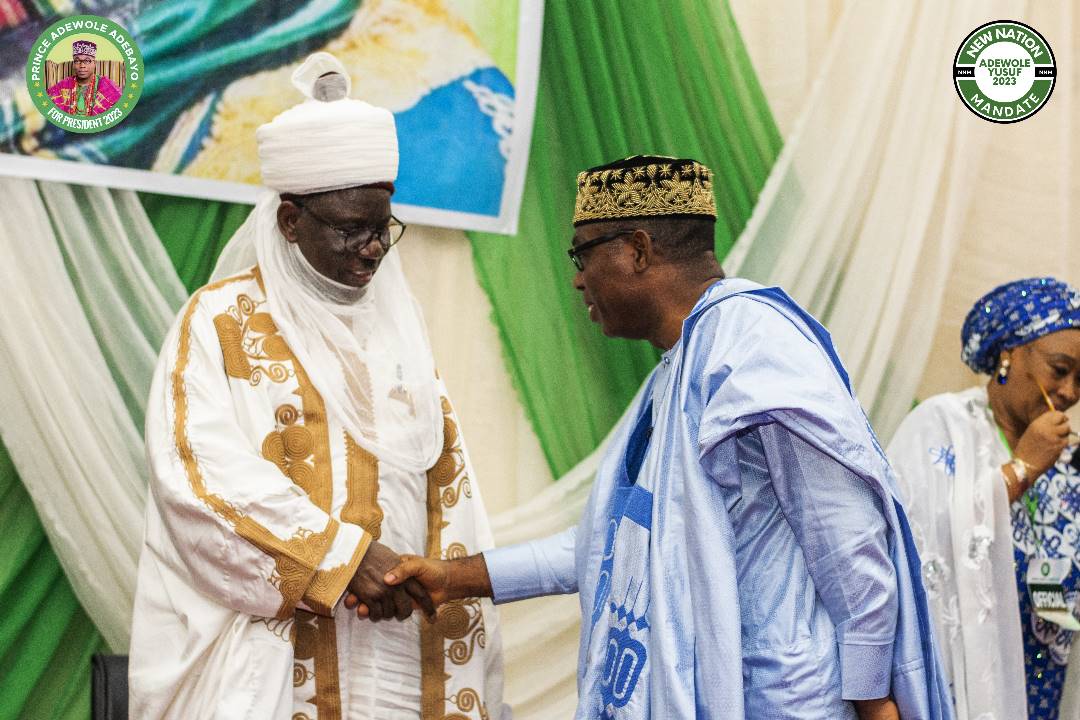
Prince Adewole Adebayo, the presidential candidate of the Social Democratic Party (SDP), has pledged that, if elected, he will deal with all the issues affecting the north.
According to him, the north has a lot of untapped potential for agriculture, people resources, and economic viability.
This was said by Prince Adewole on Saturday, October 15, in Kaduna at the Arewa Joint Committee interactive session with presidential contenders.
He pointed out that Nigeria must take use of the North’s proximity to the Mediterranean for economic gain.
Answering questions bordering on education and the Nigeria northern institution he said
“The first response to this is that education is not the same thing as Western education, education is a process by which a new generation learns the norms of the preceding generation and become functional in the environment which they are grown into and if you are lucky, the talent of one or two people will come out and the rest of society will learn it.
The educational challenge facing Nigeria, from my study of it, if you study the arguments between the Lagos elite and Lugard, you will notice that the energy that drove education during colonial rule was an attempt to replace Western officials. So we go to their school in London, Oxford, everywhere.
We were trying to replace the colonial people with our own people and would pay attention to that clerical education, whereas other countries in the world who are making progress, their educational foundation is not just to replace officials it was generally to learn anything that you can learn technically. Secondly, we thought that we had to replace our own brain with the white man’s brain.
Traditionally, we did not institutionalise the training on so many things in which we had skills, we just threw them away. So a person from a family of wood carvers or drug makers who have been doing tannery for a thousand years will go to Barewa College, forget about the tannery and learn philosophy and become a district officer; then when he retires he can’t do anything rather than moving files from place to place.
That’s the mistake we made, particularly in northern Nigeria the educational drive in northern Nigeria was initially driven by the northernisation policy to say that the gap between the education population in the south and the North needed to be bridged so that the north could take control of its administration.
So the same problem we have generally is what we have. “So what I think we should do about this is that we must get away from that and go back to an education where there is the systematisation of the learning and retention of all kinds of skills, so majority of our people learn how to be plumbers, artisans.
Just like Italians, Italians who are making 90% of the income of Italy will not attend a university at all. So I want us to have a different understanding, because if you get to England, the population of the English people who have gone to university is smaller than population of Nigerians who are going to university. But in Britain, if you are looking for a plumber, you get the best plumber, if you are looking for electrician, you have the best electrician. So we must address that issue generally”.
“Now for the formal education, the clerical part of it, the problem is we’re also creating institutions, in competition with one another. So you have ten professors, I too want to produce ten professors.
This attitude would change. One other problem with the government, which I’m going to change is that education is taken as part of government running ministries; education is supposed to be a liberalised system whereby every person from the family to the mosque, to the madrasas, the local government has input to make in educating people, and the idea that all the money for education must be in ministry of education, I will deal with it, it won’t be the case. The case will be that all traditional institutions will be able to run a school system”.
“But what we are going to do to address the issue of education is that generally the management of the economy must be such that teachers can live a comfortable life as teachers, because if we have to be truthful, if you meet somebody for the first time and you are told, you ask, who is this man? His name is Salisu. What does he do for a living? Is he a primary school teacher? You can conclude that he is a poor man right now. So that is what we need to change, we cannot address the question of education without addressing the manpower issue.
We will train more manpower, we will also make them to be able to remain as teachers and live a reasonable life, which means we will deal with the issue of inflation so that inflation doesn’t eat all your wages.
We deal with the issue of non-monetary benefits; a teacher should have a home, a teacher should have public transport to work, a teacher should have liveable pension. Lastly, we must be able to deal with the cost of living. So once we do all of those and put it down, the best talents will want to be teachers. But right now the best talents don’t want to be teachers”.
Do you have a news to share with us, or you would like to partner with us or make advert enquiry or support Kindly reach out to us on +2348036828367.