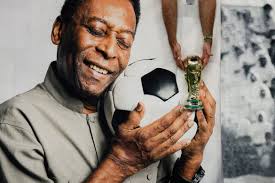
His agent, Joe Fraga, confirmed his death: “The king has passed.”
Opposing fans taunted Pelé with monkey chants at home and all over the world.
He had roles in movies, soap operas and even composed songs and recorded CDs of popular Brazilian music.
As his health deteriorated, his travels and appearances became less frequent. He was often seen in a wheelchair during his final years and did not attend a ceremony to unveil a statue of him representing Brazil’s 1970 World Cup team. Pelé spent his 80th birthday isolated with a few family members at a beach home.
Born Edson Arantes do Nascimento, in the small city of Tres Coracoes in the interior of Minas Gerais state on Oct. 23, 1940, Pelé grew up shining shoes to buy his modest soccer gear.
Pelé’s talent drew attention when he was 11, and a local professional player brought him to Santos’ youth squads. It didn’t take long for him to make it to the senior squad.
Despite his youth and 5-foot-8 frame, he scored against grown men with the same ease he displayed against friends back home. He debuted with the Brazilian club at 16 in 1956, and the club quickly gained worldwide recognition.
The name Pelé came from him mispronouncing the name of a player called Bilé.
He went to the 1958 World Cup as a reserve but became a key player for his country’s championship team. His first goal, in which he flicked the ball over the head of a defender and raced around him to volley it home, was voted as one of the best in World Cup history.
The 1966 World Cup in England — won by the hosts — was a bitter one for Pelé, by then already considered the world’s top player. Brazil was knocked out in the group stage and Pelé, angry at the rough treatment, swore it was his last World Cup.
He changed his mind and was rejuvenated in the 1970 World Cup. In a game against England, he struck a header for a certain score, but the great goalkeeper Gordon Banks flipped the ball over the bar in an astonishing move. Pelé likened the save — one of the best in World Cup history — to a “salmon climbing up a waterfall.” Later, he scored the opening goal in the final against Italy, his last World Cup match.
In all, Pelé played 114 matches with Brazil, scoring a record 95 goals, including 77 in official matches.
His run with Santos stretched over three decades until he went into semi-retirement after the 1972 season. Wealthy European clubs tried to sign him, but the Brazilian government intervened to keep him from being sold, declaring him a national treasure.
On the field, Pelé’s energy, vision and imagination drove a gifted Brazilian national team with a fast, fluid style of play that exemplified “O Jogo Bonito” — Portuguese for “The Beautiful Game.” His 1977 autobiography, “My Life and the Beautiful Game,” made the phrase part of soccer’s lexicon.
In 1975, he joined the New York Cosmos of the North American Soccer League. Although 34 and past his prime, Pelé gave soccer a higher profile in North America. He led the Cosmos to the 1977 league title and scored 64 goals in three seasons.
Pelé ended his career on Oct. 1, 1977, in an exhibition between the Cosmos and Santos before a crowd in New Jersey of some 77,000. He played half the game with each club. Among the dignitaries on hand was perhaps the only other athlete whose renown spanned the globe — Muhammad Ali.
Pelé would endure difficult times in his personal life, especially when his son Edinho was arrested on drug-related charges. Pelé had two daughters out of wedlock and five children from his first two marriages, to Rosemeri dos Reis Cholbi and Assiria Seixas Lemos. He later married businesswoman Marcia Cibele Aoki.
Do you have a news to share with us, or you would like to partner with us or make advert enquiry or support Kindly reach out to us on +2348036828367.