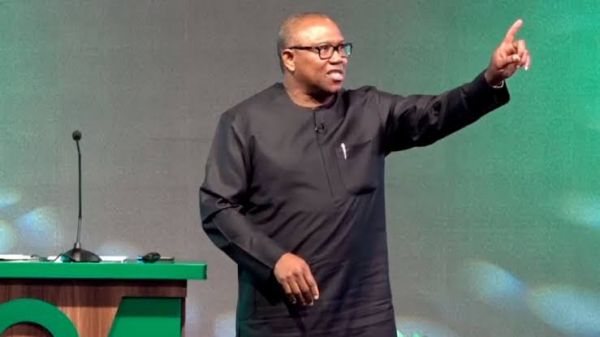
Obi has inspired a zealous movement of mostly youths and disrupted Nigeria’s traditional two-man presidential contest. But can he go all the way and win the vote?
But now, the trade union-backed Labour Party is campaigning with Peter Obi, former two-term governor of the southeastern state of Anambra, as leader – and people are taking notice.
Several polls and surveys have projected a win for Obi on February 25, including one conducted for Bloomberg News by Premise Data Corp in September 2022 in which 72 percent of respondents named him as their first-choice candidate.
Competition, however, remains stiff despite Obi’s rivals carrying plenty of baggage.
Tinubu’s choice of a fellow Muslim, Kashim Shettima, as a running mate remains divisive in a population split almost evenly between Christians and Muslims. Tickets for the major parties are usually split between the two major religions.
Both Tinubu and Abubakar can marshal immense resources and may benefit from organised party structures that could help swing the election. But Obi, who was Abubakar’s running mate in 2019, has sought to claim the moral high ground.
In the eight months since defecting from the PDP, Obi’s promises of inclusion and accountability have resonated far and wide, resulting in a groundswell of support reinvigorating an otherwise lacklustre campaign.
Numerous endorsements that have ruffled feathers in the political establishment have followed, including from former President Olusegun Obasanjo who describes Obi as a “mentee” as well as prominent author Chimamanda Ngozi Adichie who calls him her “dearest big bro”.
‘Opportunity meeting preparation’
His wealth was useful during a lengthy litigation process preceding his first stint in public office as governor of Anambra. His party at the time, the All Grand Progressives Alliance (APGA) alleged electoral malpractice against the PDP’s Chris Ngige.
Obi was also impeached by the state parliament but the courts reversed the decision.
“It is less about Obi himself and more a frustration with the status quo which he has been able to leverage. It is opportunity meeting preparation,” Anku told Al Jazeera.
As governor, Obi engineered a massive public infrastructure drive and invested heavily in primary healthcare and education. He also tried to clean up Onitsha, the commercial nerve centre of the southeast that the World Health Organization once named the world’s most polluted city.
His successors dispute the amount he reportedly left in state coffers and have jeered at his frugality. But his administration was also given high ratings by the Senate and Debt Management Office, as well as recognition by organisations like the Bill & Melinda Gates Foundation.
His frugality with government resources has since come to be one of Obi’s biggest selling points as Nigeria spends up to two-thirds of its revenue on debt obligations.
Insecurity is also rampant nationwide; for instance, armed groups like Boko Haram continue to carry out attacks in the northeast despite the government’s insistencethat things are not so.
The rise of the ‘Obidients’
Obi’s candidacy has instilled a sense of hope among some of the electorate, especially among young people who represent Nigeria’s biggest demographic – 70 percent of its estimated 200 million people are aged below 30 – but have little control over the levers of state that determine electoral outcomes.
Analysts say Obi’s swift pivot to the Labour Party represents a turning point. For a number of young people, he is perceived as the brightest hope for a country in the doldrums.
It is from this demographic that a zealous movement has arisen.
Obi’s supporters call themselves “Obidients” and have gone to great lengths to sell their candidate, including fervent evangelism on social media.
“He is proof that charisma, competence and credibility can win elections regardless of ethnicity,” Balami Isaac, deputy national campaign manager of the Obi campaign council, told Al Jazeera. “That represents hope for my people and the youth.”
Floating hope
In a country with endemic corruption, Obi, seen as a rare “principled” politician by his supporters, has repeatedly challenged critics to find any evidence of corruption tied to him or even that he has drawn a pension since exiting office.
Obi admitted to being silent about them in asset declaration filings to the Code of Conduct Bureau, in direct contravention of Nigerian law. He said he was unaware that the law required him to do so for assets jointly owned with his family members.
“I have said it repeatedly, I will sit down and discuss with every agitator,” he told Al Jazeera. “We will win those who are winnable and then deal with those who are not – carrot and stick.”
Obi has also promised to appoint a special counsel to prosecute corruption cases. He has also proposed replacing the current salary structure with an hourly productivity-based minimum rate as part of a larger drive to move Nigeria from a consumption-based economy to a production one.
Still, analysts say he is also likely to face tougher challenges if elected, as was the case during his tenure as governor.
“Also, elite consensus is a key part of fundamental reform,” she said. “Obi has struggled to get the elite even in his region to support his candidacy. It remains to be seen how he can build national consensus.”
The path to victory seems complicated even if Obi is often welcomed like a rock star as his campaign train crisscrosses Nigeria, sometimes hitting multiple locations in a day.
Cash inducement still reigns supreme in Nigerian politics, which is at odds with Obi’s famed frugality.
The Labour Party has also been dismissed as having little national appeal and his critics point to knottier issues like religion and ethnicity which can often determine how votes are cast.
Abuja-based political analyst Mark Amaza thinks making inroads into the north will be a tall order even though areas with religious and ethnic minorities appear wary of the APC’s Muslim-Muslim ticket.
“[But] even in the core north, there are large non-indigenous populations that can fetch him votes,” Amaza told Al Jazeera.
The duo insist their candidacy is not sectional but represents a different, more inclusive way of doing things. At an interactive session in Kaduna last year, Obi said simply, “I want to give Nigerians hope.”
And their message seems to be winning new support.
Do you have a news to share with us, or you would like to partner with us or make advert enquiry or support Kindly reach out to us on +2348036828367.