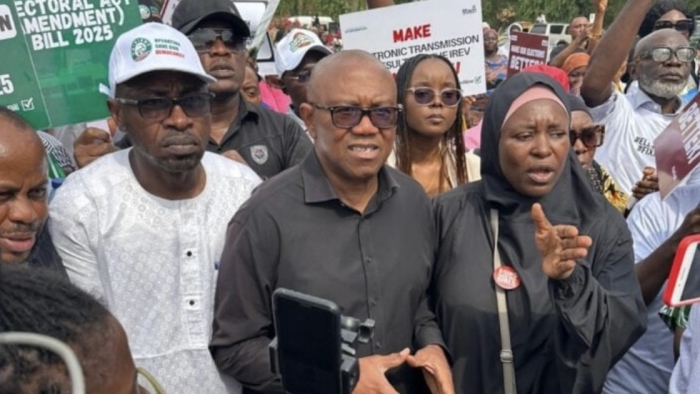
Peter Obi, the Labour Party’s 2023 presidential candidate, on Monday led a mass protest to the National Assembly Complex in Abuja to oppose the Senate’s decision to reject the real-time electronic transmission of election results.
The demonstration united student groups, civil society organisations, members of the African Democratic Congress, and supporters of the Obidient Movement, all calling for greater transparency in Nigeria’s electoral process. Protesters accused the Senate of undermining public trust by retaining discretionary powers over result transmission.
Addressing the crowd, Obi urged lawmakers to allow elections to follow a clear, predictable, and credible process. He stressed that Nigerians are willing to accept any outcome that genuinely reflects the electorate’s will and questioned why the Senate would introduce uncertainty into an already fragile system.
The protest came after the Senate passed the Electoral Act amendment bill on February 4. While the bill reduced the timeline for the Independent National Electoral Commission (INEC) to issue election notices from 360 days to 180 days, it rejected a provision making electronic transmission of results compulsory and in real time.
Clause 60(3) of the amendment bill had sought to make it mandatory for presiding officers to transmit polling unit results directly to the INEC Result Viewing Portal immediately after Form EC8A was signed and stamped. Instead, the Senate retained section 60(5) of the existing Electoral Act 2022, allowing presiding officers to transmit results at INEC’s discretion.
The decision triggered widespread public backlash, prompting the Senate to schedule an emergency plenary sitting for February 10, directed by Senate President Godswill Akpabio. The Nigeria Labour Congress has also threatened mass action, warning that the rejection of real-time transmission threatens electoral credibility.
Analysis:
The Senate’s refusal to make real-time electronic transmission mandatory highlights a broader pattern of legislative self-preservation over transparency. By discarding a provision that would have legally locked transparency into the electoral process, lawmakers reinforced public suspicion that reforms are only embraced when they pose no threat to entrenched interests. The protests led by Peter Obi underscore a growing national frustration with a political class resistant to reforms capable of restoring trust, accountability, and credibility in Nigeria’s democracy.
Do you have a news to share with us, or you would like to partner with us or make advert enquiry or support Kindly reach out to us on +2348036828367.