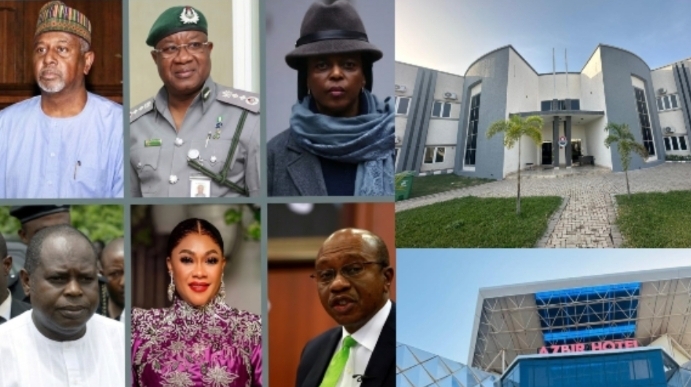
Several prominent Nigerians have forfeited cash, properties and other assets to the Federal Government following investigations and court proceedings over allegations of corruption, fraud, money laundering and abuse of office.
The forfeitures, which followed rulings by various courts, have involved former governors, ministers, security chiefs, senior public officials and businessmen.
Among the prominent cases is that of Godwin Emefiele, former Governor of the Central Bank of Nigeria, who forfeited several properties and other assets, including cash, share certificates and luxury properties linked to financial crime proceedings against him.
Former Plateau State Governor Joshua Dariye, who was convicted and sentenced to 14 years in prison over corruption, also forfeited properties and funds. His conviction was later followed by a presidential pardon in 2022.
Another former governor, Jolly Nyame of Taraba State, was convicted over the diversion of state funds and ordered to forfeit assets linked to the offences. He was also among those pardoned in 2022.
Former Inspector-General of Police Tafa Balogun forfeited cash and properties following his conviction for offences bordering on money laundering, theft and misappropriation of police funds. The court proceedings resulted in the recovery of more than N2.2 billion traced to his accounts.
Former Petroleum Minister Diezani Alison-Madueke has also been involved in extensive forfeiture proceedings involving properties, cash and other valuables in Nigeria and abroad.
Former National Security Adviser Sambo Dasuki forfeited several assets and properties following multiple criminal proceedings involving alleged diversion of public funds.
The list also includes former JAMB Registrar Dibu Ojerinde, who forfeited properties, including schools and other assets, following proceedings over alleged financial crimes.
Former Nigeria Customs Service Comptroller-General Abdullahi Dikko also forfeited properties, vehicles and cash following proceedings over alleged diversion of funds from the service.
Former Pension Reform Task Team chairman Abdulrasheed Maina, who was convicted for money laundering, forfeited houses, estates and companies located in several states.
Other former public officials who have been involved in forfeiture proceedings include former Niger State Governor Babangida Aliyu, former Bauchi State Governor Isa Yuguda, former Enugu State Governor Chimaroke Nnamani, former PDP National Chairman Iyorchia Ayu, former Accountant-General of the Federation Jonah Otunla and former Chief of Defence Staff Alex Badeh.
Former Chief of Air Staff Adesola Amosu also forfeited financial assets following proceedings over alleged diversion of funds, while former Director of Finance at the Nigerian Air Force Jacobs Adigun forfeited properties linked to a multibillion-naira fraud case.
Former First Lady Patience Jonathan was ordered to permanently forfeit funds held in several bank accounts after a court ruled on the forfeiture proceedings.
Businessmen and private individuals have equally featured in major asset forfeiture cases.
They include Kola Aluko, an associate of Alison-Madueke, who forfeited properties; businessman Jide Omokore, who was involved in forfeiture proceedings involving assets in Nigeria and the United Kingdom; and Abidemi Rufai, a former aide to the Ogun State governor who was convicted in the United States over wire fraud and identity theft and subsequently forfeited assets.
Other cases include those involving Nuhu Jamari, a former managing director of an NNPCL subsidiary; retired Major-General Emmanuel Atewe; retired Major-General Umar Muhammad; and former Platinum Multi-Purpose Cooperative Society Managing Director Michael Obasuyi.
The forfeiture proceedings have largely been driven by anti-corruption agencies, particularly the Economic and Financial Crimes Commission (EFCC), with courts determining whether the assets should be permanently forfeited to the government.
The cases demonstrate the increasing use of asset recovery as part of Nigeria’s fight against financial crimes, with recovered funds and properties potentially returning value to the public.
However, forfeiture proceedings remain subject to the specific findings and orders of the courts in each case, and allegations against individuals should not be treated as convictions unless a court has established their guilt.
Do you have a news to share with us, or you would like to partner with us or make advert enquiry or support Kindly reach out to us on +2348036828367.