Food is one of those things people can take for granted until they cannot afford what they need, until a farmer struggles to find a reliable market, or until a community discovers that having enough food does not necessarily mean eating well.
In Nigeria, the conversation about food goes beyond what is available on the shelf. It is about nutrition, household livelihoods, public health and the systems that connect farmers to manufacturers, manufacturers to consumers, and communities to opportunities.
These connections are easy to overlook. But they are where some of the country’s most persistent development challenges meet.
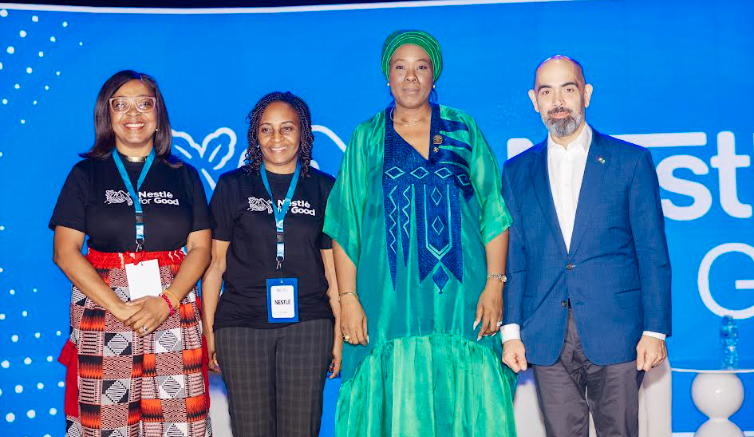
It was against this backdrop that Nestlé Nigeria convened the Nestlé for Good Summit 2026 in Lagos, bringing together government representatives, healthcare professionals, development partners, academics, industry leaders, civil society organisations and the media to discuss practical ways of improving nutrition, strengthening communities and supporting more sustainable food systems.
Among those present were Lagos State Commissioner for Commerce, Cooperatives, Trade and Investment, Mrs Folashade Bada Ambrose-Medebem, and Commissioner for Health, Professor Akin Abayomi.
The gathering brought different parts of the food and development landscape into the same room. The challenge now is to determine what that collaboration can deliver beyond the conversations.
Because bringing stakeholders together is one thing. Changing outcomes for the people they serve is another.
For a country dealing with interconnected nutrition, public health and food-system challenges, the distinction matters. The availability of food does not automatically guarantee a balanced diet. Agricultural production does not always translate into stable incomes for farmers. And a community development programme does not necessarily produce lasting change simply because it has been launched.
The real work lies in connecting these pieces and measuring what changes as a result.
Nestlé Nigeria’s approach, presented through its Nestlé for Good platform, brings the company’s activities together under three broad areas: Nutrition, Thriving Communities and the Planet.
Speaking at the Summit, the company’s Managing Director and Chief Executive Officer, Wassim Elhusseini, described the approach as an expression of its purpose and commitment to creating shared value.
“At Nestlé, we are guided by a simple but powerful purpose: to unlock the power of food to enhance quality of life for everyone, today and for generations to come,” he said.
He explained that delivering food consistently and at scale depends on systems that extend from responsible sourcing and manufacturing to distribution, livelihoods, capability development and environmental sustainability.
It is a broad view of what a food company does. Its influence does not begin and end with the products consumers purchase. It also extends to the people who supply its raw materials, the communities around its operations and the environmental resources on which production depends.
But a broad commitment also requires careful scrutiny.
The question is not simply whether a company has initiatives addressing nutrition, livelihoods and sustainability. It is whether those initiatives are improving people’s lives, how widely the benefits extend and whether the improvements can be sustained.
Nutrition is a useful place to begin.
Food production and consumption are often discussed in terms of availability, but nutrition requires a closer look at quality, affordability and dietary needs. The challenge involves more than getting food into the market. It also concerns whether people can access and afford the variety of foods needed for healthy diets.
At the Summit, stakeholders explored practical pathways to improving nutrition across different stages of life. The discussions also considered how collaboration could help address challenges that cut across public health, livelihoods and environmental sustainability.
Lagos State Commissioner for Commerce, Cooperatives, Trade and Investment, Folashade Bada Ambrose-Medebem, connected the conversation to the country’s wider development prospects.
“The conversations we are having today are not only about food. They are about human capital, productivity, public health, economic growth, and ultimately, the future of our society,” she said.
Her observation points to an important relationship. Nutrition is not only a household concern or a matter for healthcare professionals. It is also connected to people’s capacity to learn, work and contribute to economic activity.
That makes cooperation between government and industry relevant. Businesses have production capacity, distribution networks and supply chains. Government institutions have responsibilities for public health, regulation and development policy. Researchers and development organisations can contribute evidence and expertise.
Yet collaboration must be judged by what it achieves, not simply by the number of organisations involved.
For nutrition programmes, meaningful assessment requires evidence of their reach, the needs they address and the outcomes they produce. The existence of a programme is a starting point, not proof of improved nutrition.
The same distinction applies to the communities behind the food system.
Nestlé for Good also brings attention to livelihoods and capability development, recognising that the strength of a food system depends partly on the people who sustain it.
At the Summit, an impact showcase featured stories connected to women’s empowerment, youth capability development, dairy development and environmental sustainability. The presentations offered participants an opportunity to engage with examples of interventions linked to the company’s work across the value chain.
These areas matter for different reasons.
For women, access to skills, resources and economic opportunities can influence household stability and financial independence. For young people, training can open doors to employment or entrepreneurship. For dairy farmers, development initiatives can support participation in a supply chain that connects agricultural production with commercial markets.
But the real value of such interventions becomes clearer when the focus shifts from activities to outcomes.
How many people have acquired skills they can use? How many have secured employment or established viable businesses? Have participating farmers improved their productivity or achieved more reliable incomes? Are the benefits continuing after the initial support ends?
Those questions are not criticisms of the programmes. They are the questions required to understand whether an intervention is working.
A training session may be completed in a day. Building a sustainable livelihood can take years.
Victoria Uwadoka, Nestlé Nigeria’s Corporate Communications, Public Affairs and Sustainability Lead, said the platform was intended to show how the company’s products, sourcing, partnerships and community investments connect to support healthier lives and more resilient communities.
“Nestlé for Good is not simply about showcasing individual initiatives. It is about demonstrating how our products, sourcing, partnerships, and community investments connect in practical ways to support healthier lives and more resilient communities,” she said.
The emphasis on connections is important because development challenges rarely exist in isolation.
A farmer’s livelihood, for instance, can be influenced by access to markets, production costs, the reliability of buyers and the resources available to improve farming practices. A young person’s training may have limited value without opportunities to apply the skills acquired. Women’s empowerment initiatives may achieve more when participants can access the tools and markets needed to turn opportunities into sustainable income.
The strength of an intervention, therefore, depends not only on what it offers but also on the conditions that allow its benefits to endure.
Then there is the planet, the third pillar of the Nestlé for Good framework.
Food systems depend on natural resources at every stage, from agricultural production to processing, packaging and distribution. Environmental sustainability is consequently tied to the long-term viability of the same systems that provide food and livelihoods.
The Summit placed environmental sustainability alongside nutrition and thriving communities, reflecting the interconnected nature of these priorities.
Patricia Ekaba, Head of Corporate Communications, Public Affairs and Sustainability for Central and West Africa, highlighted the importance of looking beyond immediate interventions.
“Sustainable progress requires looking beyond short-term interventions. Business growth and social progress are interconnected, and lasting impact comes from creating value for both the business and the communities it serves,” she said.
The principle raises a practical question for businesses: how can commercial growth be aligned with improvements in community wellbeing and responsible use of environmental resources?
The answer requires more than commitments. It requires evidence that progress in one area is not being achieved at the expense of another.
Environmental programmes, for example, must be assessed by the changes they produce and sustain. Community initiatives need to demonstrate benefits that extend beyond launch events. And nutrition interventions should be evaluated by their contribution to better outcomes, rather than by the number of activities completed.
This is where consistent measurement becomes essential.
A company may report the number of beneficiaries reached, the partnerships established or the programmes introduced. Such figures can help explain the scale of its activities, but they do not always reveal the depth of the impact.
The number of people trained does not automatically tell us how many found work. The number of farmers engaged does not establish whether their incomes improved. And the number of communities reached does not, by itself, demonstrate that living conditions have become better.
To understand the difference, organisations need to track results over time, disclose the basis of their claims and identify where programmes have fallen short.
This also creates an opportunity for stakeholders beyond the company to contribute to the assessment. Government agencies, researchers, civil society organisations and communities can help establish priorities, evaluate results and identify areas requiring further attention.
For Nestlé Nigeria, the Summit provides a platform for building these relationships and bringing different perspectives into the discussion.
But the success of the platform will ultimately depend on what follows the gathering. Partnerships must translate into clearly defined actions. Commitments need measurable objectives. And the people expected to benefit should have a meaningful role in determining whether the interventions meet their needs.
The task is not a small one. Nutrition, livelihoods and environmental sustainability each involve challenges that cannot be resolved through a single event or by one organisation acting alone.
That is precisely why sustained collaboration matters.
By bringing these issues together under Nestlé for Good, Nestlé Nigeria has presented a framework for considering the relationship between business activity and wider social and environmental outcomes.
The next step is to demonstrate the results with evidence that can be examined over time.
By 2030, the more important questions will not be how many summits were convened or how many initiatives were announced. They will be whether more people have access to nutritious food, whether farmers and other participants in the food value chain have more secure livelihoods, whether skills programmes have opened lasting economic opportunities, and whether environmental practices have produced measurable improvements.
Those are the outcomes against which commitments must be judged.
A summit can bring stakeholders together. It can create space for dialogue, establish shared priorities and encourage new partnerships.
But the real measure of progress lies beyond the meeting room, in the lives of the people those partnerships are intended to serve.
That is where the promise of Nestlé for Good must be tested.
And that is where the evidence will matter most.
Do you have a news to share with us, or you would like to partner with us or make advert enquiry or support Kindly reach out to us on +2348036828367.