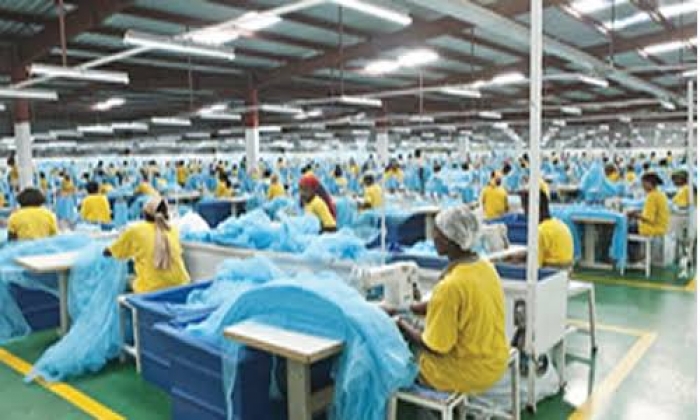
Nigeria’s manufacturing activity shrank for the second straight month in November, affected by rising price levels that kept customers at bay.
This is contained in the Stanbic IBTC Bank Nigeria Purchasing Manager Index (PMI) released Friday.
PMIs track the prevailing direction of economic trends in manufacturing and service sectors, providing credible data on business conditions to analysts, decision-makers and investors.
A reading above 50 indicates an improvement, while that below that threshold means a contraction.
The report said Friday that the country’s PMI for November was 48, down from 49.1 the month before.
New orders and output both receded in the face of surging purchase prices, which accelerated at the quickest rate in two years, spurred by exchange rate volatility and jumps in fuel and material costs.
All that happened as Nigeria’s inflation hit its most elevated level in 18 years, setting business activity up for its sharpest decline since the cash crunch early in the year.
“The heightened inflationary environment appears to depress consumer demand considerably as lack of customers was a reason for the reduced output,” Muyiwa Oni, head of Equity Research West Africa at Stanbic IBTC Bank, said.
“Sharp increases in prices deterred clients from making new orders during November. As a result, new business decreased for the second consecutive month.”
Wholesale and retail companies were most hurt by the slump. Meanwhile, agriculture was the only sector that reported an expansion in output.
Companies jacked up selling prices significantly again apparently in response to soaring input costs, passing costs on to customers. That could increase the inflation rate for the month further when the consumer price index is issued later in December.
Stanbic IBTC Bank Nigeria PMI observed that roughly half of the purchasing managers it surveyed increased their charges during the month.
Business confidence was at its lowest ebb since July, caused by anxieties around the effects of inflationary pressure on demand.
On the upside, staffing levels increased for the seventh successive month in November.
“Wages also increased as companies looked to help staff with higher living and transportation costs,” the document said.
Another bright spot was that business investment and plans to start new plants strengthened the hope that output would improve in the year ahead.
Do you have a news to share with us, or you would like to partner with us or make advert enquiry or support Kindly reach out to us on +2348036828367.