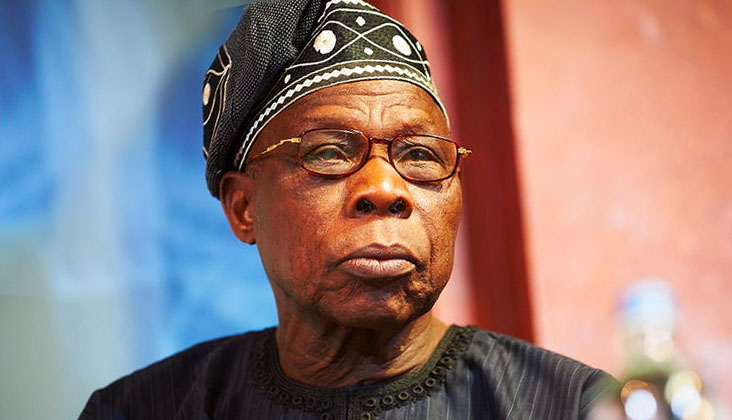
Former President Olusegun Obasanjo has warned that many of the issues that led to Nigeria’s 1967 civil war are still present, urging Nigerians to do everything possible to prevent another national conflict.
Obasanjo spoke on Wednesday while receiving a collection of books, research materials, videos and eyewitness interviews documenting the Asaba Massacre and other civil war events. The materials were presented by Chief Chuck Nduka-Eze, Chairman of the Asaba Memorial Trust and the Asaba Image Branding and Project Committee, at the Olusegun Obasanjo Presidential Library (OOPL) in Abeokuta.
The former president praised the effort to preserve the country’s history, describing it as an important step toward national healing and ensuring future generations understand the consequences of war.
“We preserve the past, capture the present and inspire the future,” Obasanjo said. “Understanding what happened is essential if we truly want to prevent it from happening again.”
Reflecting on the civil war, Obasanjo, who served as a military commander during the conflict, acknowledged his involvement but maintained that he could not give a detailed account of the Asaba Massacre because military operations in the area were under the command of the late former Head of State, Gen. Murtala Mohammed.
He recalled that toward the end of the war, he was assigned responsibilities aimed at preventing further civilian killings and insisted that abuses committed by soldiers were never officially approved.
Obasanjo recounted an incident in which he personally stopped a soldier from sexually assaulting a woman in Asaba, saying leaders must take responsibility for the conduct of those under their command.
He also noted that former Head of State, Gen. Yakubu Gowon, had publicly acknowledged and apologised for the excesses committed during the civil war, stressing that atrocities such as the Asaba Massacre were neither authorised nor condoned at the highest level of government.
Warning against renewed division, Obasanjo said Nigeria has already paid too high a price for war.
“Some of the things that led to the civil war are still with us,” he said. “We have fought one civil war too many. God forbid that this country should witness another one.”
He called on Nigerians to embrace the principle of “Never Again,” urging citizens to confront historical grievances, condemn past atrocities and work together to strengthen national unity.
The former president promised to study the materials presented to him, saying documenting the truth is vital for reconciliation and lasting peace.
Presenting the documents, Chief Chuck Nduka-Eze said the compilation contains eyewitness accounts, archival records, recorded interviews and scholarly research that collectively provide detailed evidence of the events surrounding the Asaba Massacre.
According to him, the records show that civilians were assembled, instructed to publicly affirm their loyalty to Nigeria, separated by gender, and that many unarmed men were subsequently killed despite complying with those instructions.
Nduka-Eze said available evidence points to the deaths of more than 1,000 men, describing the massacre as one of the darkest chapters of the Nigerian Civil War.
He argued that unresolved grievances, ethnic distrust and the absence of accountability contributed to both the civil war and the Asaba Massacre, warning that many of those underlying issues remain unresolved today.
Do you have a news to share with us, or you would like to partner with us or make advert enquiry or support Kindly reach out to us on +2348036828367.